Pedro Páramo Lets Comala Go Hungry in Revenge
Pedro PáramoPedro Páramo’s starvation of Comala is a calculated reprisal: after the town’s noisy festivities eclipse Susana San Juan’s burial, he shuts himself away and stops acting on its behalf. The episode turns private bereavement into collective punishment, showing how the authority he has built over land and resources can reach beyond the Media Luna and make an entire town bear the cost of his grievance.
Economic Power and Retaliation
The retaliation follows a longer pattern of converting financial pressure into control. When the estate’s accounts are discussed, its affairs are described as dire: the last cattle have been sold, and debts remain. Pedro is less interested in the amount owed than in identifying the creditors. Fulgor Sedano reports that the Preciado women are owed the most and have received the least; Pedro orders him to begin settling accounts with them, then directs him to seek Dolores Preciado’s hand in marriage. He tells Fulgor that his declaration of love is for her money. The episode establishes a ruler who treats debt, marriage, and property as instruments in the same struggle for power.
His command over the estate is also made visible in the movement of its herds. In heavy rain, two hundred mounted men leave the Media Luna gate in succession, carrying Fulgor Sedano’s orders to move cattle between pastures. This scene does not describe the later famine itself, but it shows the scale of the organization and resources under Pedro’s command. His decision to let Comala go hungry is therefore framed against an estate whose operations he can direct.
Susana’s Burial and Comala’s Celebration
The immediate cause of Pedro’s reprisal is the contrast between mourning at the Media Luna and festivity in Comala. Susana San Juan is buried, but few in the town notice. The bells draw people from Comala and beyond; visitors arrive as if on pilgrimage, and entertainers, musicians, and festivities gather until the funeral observance has become a public celebration. Even after the bells stop, the crowds remain, and more people arrive.
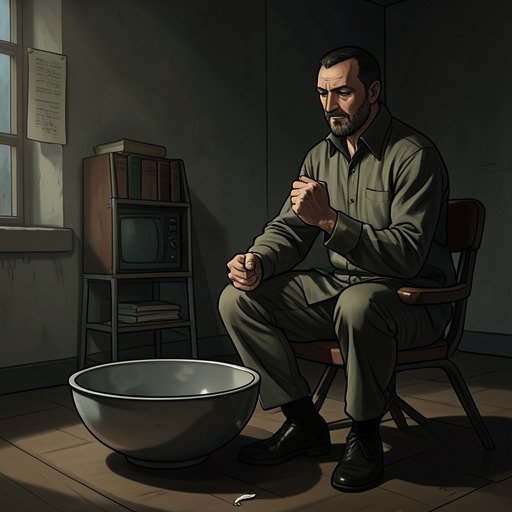
At the Media Luna, the atmosphere is the opposite: the estate is solitary and quiet, its inhabitants walking barefoot and speaking softly. The village’s lights reach the estate like a halo, while the days there are described as gray and sad. Pedro says nothing and does not leave his room. The scene sets the public noise of Comala against his silence, and makes the town’s failure to share in the burial the grievance to which he responds.
The Hunger Policy
Pedro’s response is a vow of deliberate inaction: he will fold his arms and let Comala starve. The narration immediately confirms that he carries it out. The force of the policy lies in its refusal of ordinary stewardship. Rather than attack the town openly, Pedro withdraws the support on which its inhabitants depend, turning his ability to act—or not act—into a weapon.
That choice extends his personal retaliation across the community. The people who celebrated while the Media Luna mourned become the targets of a punishment that does not distinguish among them. The account gives no measure of how long the deprivation lasts, but it makes the intention and its execution explicit: Pedro resolves to starve Comala, and Comala is left to suffer the consequences.
Significance
The episode links Pedro’s private loss to the material order he has established. His silence after Susana’s burial is not reconciliation or retreat from power; it precedes a decision that uses that power against the town. Earlier dealings show him seeking leverage through debts, property, and marriage, while the movement of cattle demonstrates the estate’s command of labor and resources. The starvation policy is the same logic at its most destructive: control over the means of life becomes a means of revenge.
The funeral’s transformation into a celebration sharpens the reversal. Comala’s crowds treat the bells as an occasion for festivity, while the Media Luna remains in mourning; afterward, Pedro makes the town’s prosperity answer to his own grievance. The episode thus presents the hunger not as an accident of scarcity but as a punishment he intends and enacts.